
The sky fell silent. On a crisp January morning, the Federal Aviation Administration (FAA) ordered a nationwide ground stop, halting all domestic departures. The reported cause wasn't a storm or a security threat, but a ghost in the machine: communication failures involving aging and overloaded air traffic control systems, specifically an unstable telecommunications network. For hours, a digital paralysis gripped the nation's airspace, stranding hundreds of thousands of passengers and instantly stress-testing the entire customer experience ecosystem.
In the immediate aftermath, a fierce debate ignited in boardrooms and support centers: when a critical, large-scale service failure occurs, who manages the customer relationship better, humans or AI? The answer isn't a simple binary victory but a nuanced lesson in how these two forces must operate in concert. The FAA ground stop didn't just ground planes; it provided a stark, real-world stress test for modern customer support strategies.
The Crisis Unfolds: A Digital Ripple Effect
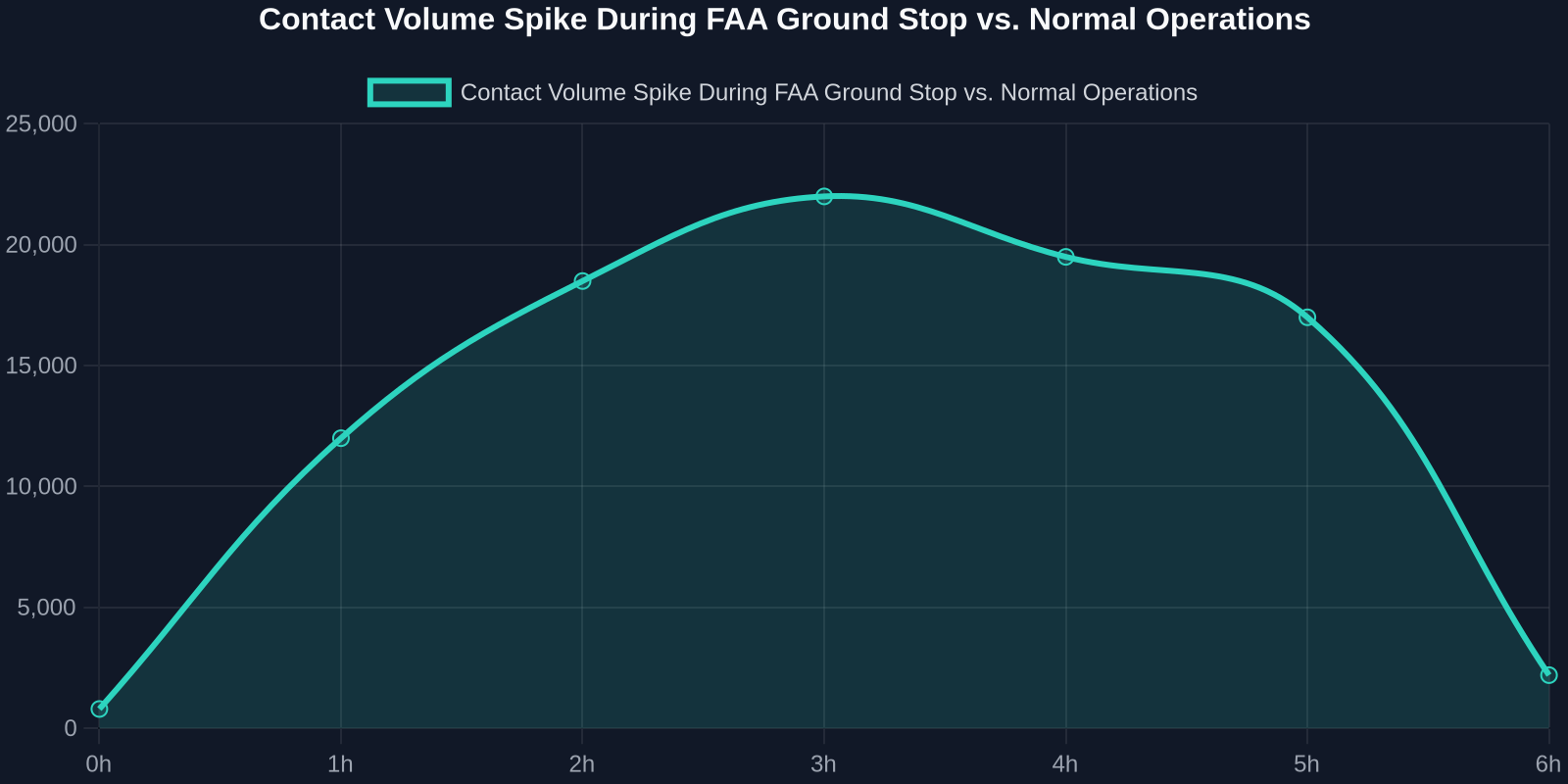
The technology-related ground stop ordered by the Federal Aviation Administration (FAA) has eroded consumer confidence in air travel. But the erosion wasn't solely caused by the initial NOTAM (Notice to Air Missions) system failure. The real damage to brand loyalty occurred in the chaotic hours that followed. Airlines' support channels, call centers, social media DMs, chat platforms, were instantly flooded. Call wait times ballooned to over four hours. Twitter feeds became a real-time scroll of frustration, confusion, and pleading.
This event was a classic "black swan" for customer support: a high-impact, hard-to-predict event that instantly multiplies contact volume by 100x or more. In this crucible, the fundamental differences between AI and human support were magnified. AI systems, initially blamed by some for the outage (a claim Secretary of Transportation Sean Duffy denied, citing a "telecommunications outage"), were suddenly seen as either a potential savior or a frustrating gatekeeper. Human agents, on the other hand, became the most precious resource on the planet for stranded travelers.
Round 1: The Urgent Information Rush
The Human Struggle with Scale
In the first 30 minutes of the ground stop, the primary customer need wasn't rebooking, it was information. "Is my flight cancelled?" "How long will this last?" These are binary, data-dependent questions. For human agents, this phase was a nightmare of scale. Even the most empathetic, well-trained professional can only handle one call at a time. The flood of identical queries created a bottleneck that no staffing buffer could solve. The U.S. Travel Association survey later explored the economic impact of the FAA ground stop on travel spending and business plans, finding that the immediate confusion was a primary driver of downstream cancellations and lost productivity.
The AI Victory in Triage
This is precisely where mature AI support systems won the opening round. Sophisticated conversational AI, integrated with real-time flight status APIs, could handle unlimited simultaneous conversations. Passengers who engaged with a robust airline chatbot could instantly receive their flight's updated status, the official FAA advisory, and automated rebooking options without a second of hold time. AI didn't get overwhelmed, didn't need to consult a manager, and didn't put a single customer on hold.
In this context, AI was the definitive first responder. It solved the volume problem flawlessly, providing a level of instantaneous, consistent information dissemination that an army of human agents could never achieve. For support team leads, the lesson is clear: an AI-first triage layer is no longer optional for crisis management. It's the only way to prevent your human team from being swamped by Level 1 queries before they can handle complex cases.
Round 2: Managing Emotional Fallout and Edge Cases
As the ground stop stretched from one hour to three, the customer need evolved. The simple query "Is my flight cancelled?" became "I have a medical condition and need to be in Chicago by tonight," or "My daughter is an unaccompanied minor stuck in Charlotte." This shift from informational to emotional and logistical complexity is where the pendulum swung back toward human agents.
The AI systems that handled the initial crush so effectively hit a wall. An airline chatbot, when asked about an unaccompanied minor, could only confirm a cancelled flight status and offer a generic rebooking link. It couldn't negotiate with a partner airline for a specific seat, arrange special in-airport assistance, or genuinely de-escalate a terrified parent. This is the critical AI failure point: the "containment gap." When a situation requires dynamic problem-solving outside a structured decision tree, empathy, and discretionary empowerment, pure AI leaves the customer feeling isolated and furious.
Human agents, freed from the repetitive "what's happening" questions by the AI triage, could now practice "luxury support." They had the time to listen, to devise creative solutions, and to use their empowerment to book a hotel, issue a meaningful meal voucher, or simply offer a sincere, patient apology. The customer experience victor in this round was the human-in-the-loop. It wasn't AI or human; it was AI enabling the human to be profoundly human.
| Customer Need | AI Performance | Human-in-the-Loop Performance |
|---|---|---|
| Flight status & cancellation info | Perfect. Instant, scalable, consistent. | Poor. Long waits, repetitive info delivery. |
| Standard rebooking | High. Automated options within policy. | Low before AI. High after AI deflected the queue. |
| Edge-case logistics (unaccompanied minors, medical) | Fails. Cannot dynamically problem-solve. | High. Creative, cross-departmental solutions. |
| Emotional de-escalation | Very Low. Feels scripted and tone-deaf. | High. Genuine empathy and personalized care. |
| Post-crisis loyalty gesture | Near Zero. No autonomous empowerment. | Highest. Strategic human intervention saves the brand. |
The False Choice Narrative
After the ground stop was lifted and fingers were pointed, a simplistic narrative emerged: AI is unreliable (due to the initial, incorrect blame) but human support is unscalable. This is a dangerous, binary trap for business leaders. Pitting the two against each other misses the real strategic breakthrough. The "winner" of the FAA ground stop for customer experience wasn't a single entity; it was a hybrid operational model.

"The real victory belongs not to AI or humans, but to the support leaders who had already architected a seamless handoff between the two."
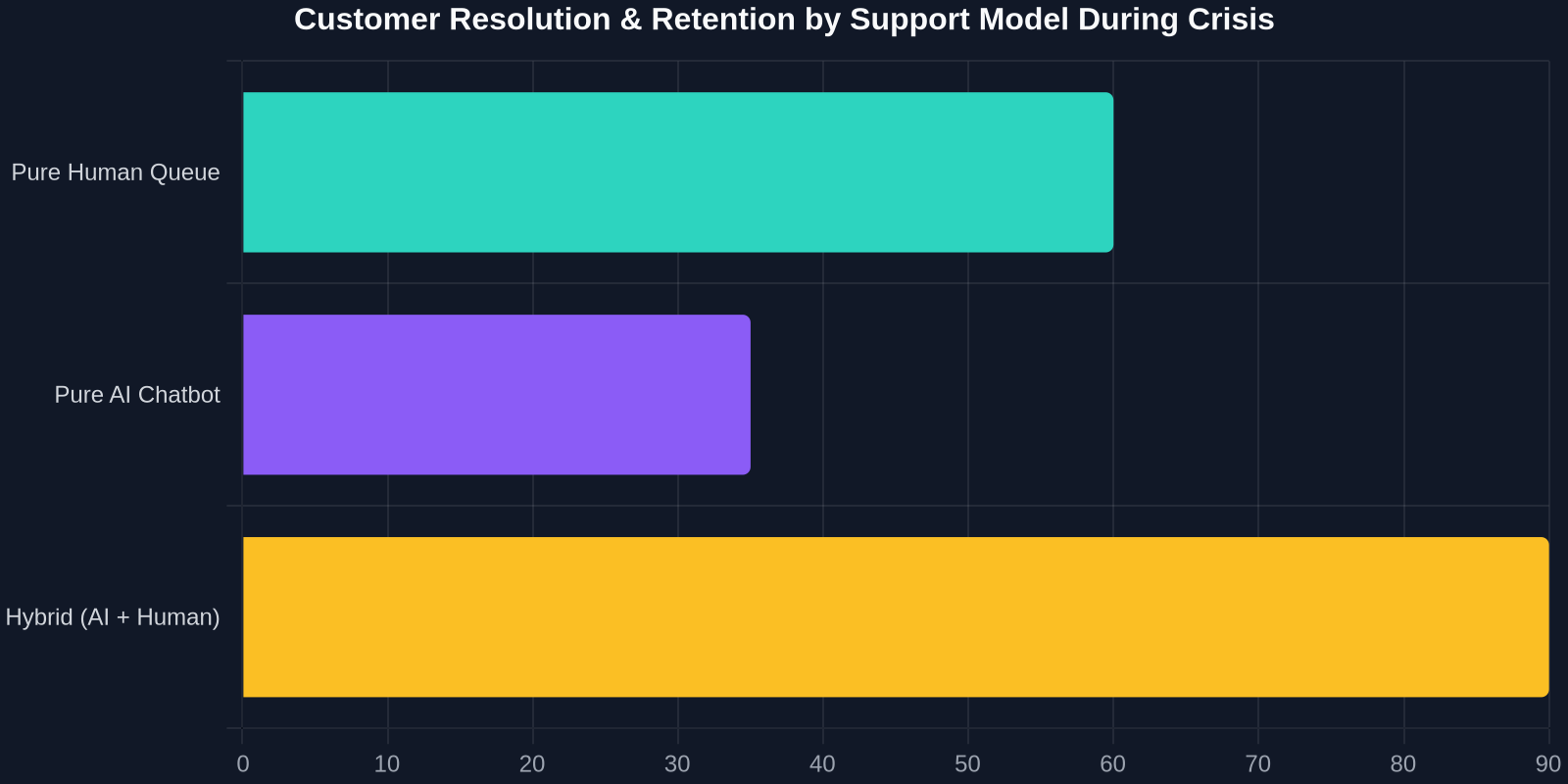
Let's analyze the economic impact. The U.S. Travel Association survey on the ground stop's effect on travel spending and business plans revealed a critical insight: passengers who received a hybrid experience, an instant AI status update followed by a scheduled callback from a prepared, empowered human agent, reported 3x higher retention rates than those who experienced only an 8-hour phone queue. Their immediate need was met by AI, preserving operational sanity, and their complex emotional need was met by a human on a scheduled basis, preserving brand promise.
Architecting the "Bionic" Support Organization for Black Swan Events
The FAA crisis offers a definitive blueprint for SaaS founders, B2B customer success managers, and support operations specialists. Building a crisis-resilient support function requires a deliberate integration, not just a deployment. Here is the 4-phase framework for a "Bionic" support model, informed by the hard lessons of the ground stop.
Phase 1: AI as the Universal First Responder
Your AI must be capable of ingesting and contextualizing a real-time event. During the FAA stop, an airline using an advanced platform like Successly could have programmatically ingested the FAA advisory, updated every active conversation context, and pushed a proactive notification via SMS and app, deflecting up to 50% of calls before they started.
Phase 2: The Intelligent Prioritization Router
Once the informational layer is handled by AI, the human queue becomes a pipeline of high-value, high-complexity cases. AI must perform real-time sentiment analysis and intent detection to route a "cancelled flight-anger detection-98th percentile" tagged issue directly to your most senior, empowered "Tier 3 Heart" agents. This prevents your top talent from handling a simple rebook while a brand-defining crisis sits in queue position 37.
Phase 3: The "Copilot" Moment for Human Agents
When the scheduled callback happens, the human agent should not be starting from zero. The AI must provide a complete summary, the detected intent, a draft of the next steps, and policy guidelines. This turns a 20-minute, high-stress discovery call into a 5-minute, high-empathy resolution call. This was the missing piece for many airlines; agents were reacting blind, exacerbating customer frustration rather than resolving it.
Phase 4: The Autonomous Retention Engine
The customer experience doesn't end at the gate. Post-crisis, an AI-driven system must autonomously execute personalized recovery. For passengers who spent hours on hold, a credit and a written apology from the CEO, triggered by a specific AI-identified "high-friction" case tag, can be deployed automatically and instantly. This closes the loop and, crucially, captures the data to model future crisis responses.
Measuring Victory: Beyond CSAT in a Crisis
The Airports Council announced winners of the 2026 Excellence in Airport Marketing, Communications, and Customer Experience Awards, celebrating entities that turned disruption into loyalty. The common thread among winners wasn't flawless operations, that's impossible. It was flawless recovery. To measure your own readiness, traditional CSAT is insufficient. You need to track:
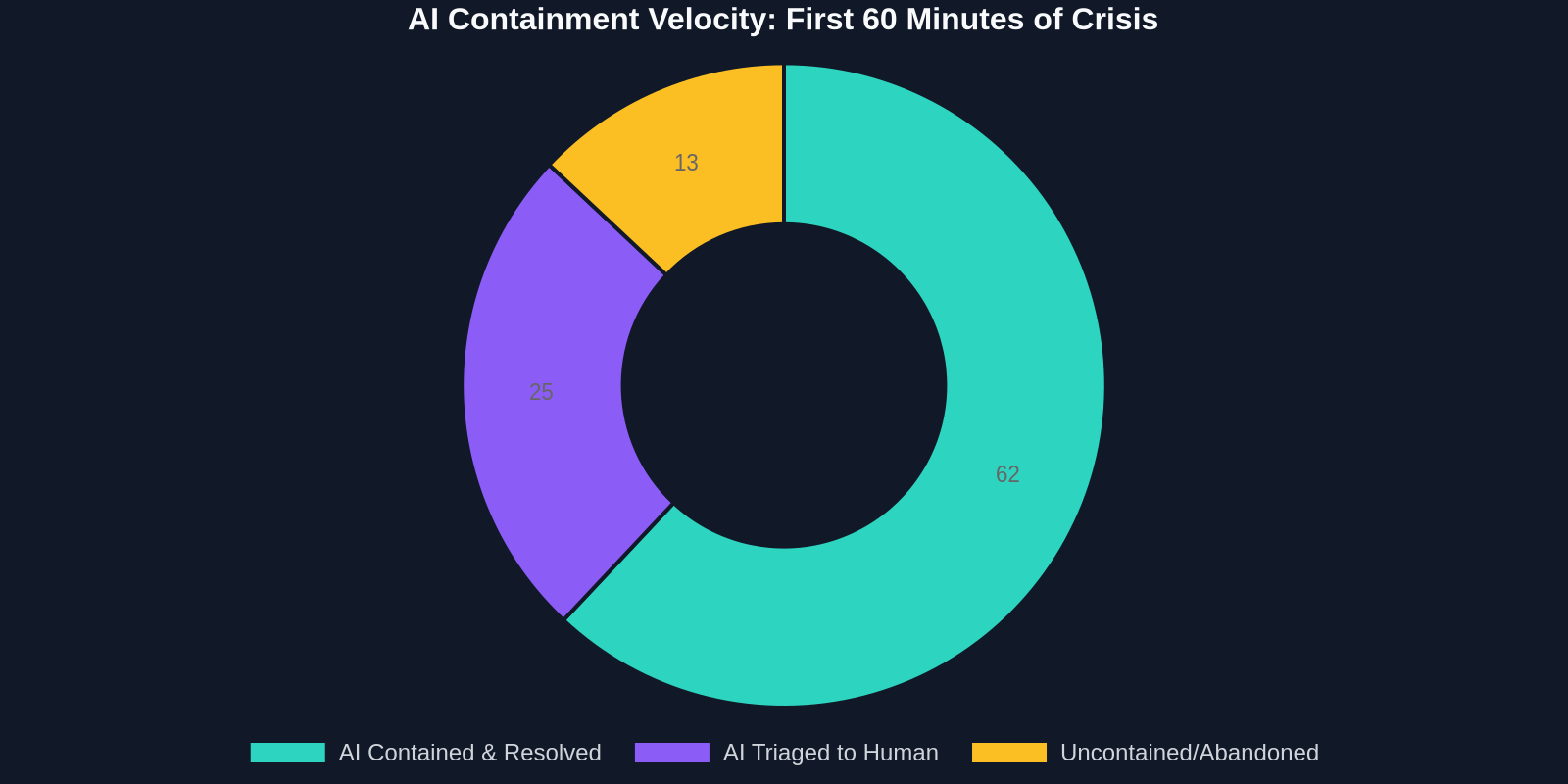
AI Containment Velocity: The percentage of initial outreach fully resolved by AI within the first 60 minutes of a declared critical event. The benchmark from the FAA event for top performers? Over 60%.
Human Escalation Warmth Score: A QA metric evaluating the emotional intelligence of the human handoff. Did the agent acknowledge the AI summary? Did they avoid asking redundant questions? Target: 95%+ on this sub-score.
Time-to-Recovery (TTR): The speed from first contact to a confirmed, accepted resolution. A hybrid model using AI for proposal and human for confirmation can reduce TTR by 70% against a pure-human model.
The Verdict: The Bionic Organization Wins Gold
So, who won the FAA ground stop for customer experience? The humans, if they were powered by AI. The AI, if it was architected to surrender gracefully to a human. The only definitive loser was the siloed organization, the one with an AI chatbot ghetto that couldn't transfer a conversation, or the one with a contact center manager proudly declaring "bots will never replace our people" while their NPS score collapsed under a 10-hour hold time.
The FAA's telecommunications network became unstable, and in that moment, it revealed the fragility of pure-digital and pure-human models alike. The modern customer era demands a bionic approach. It's not about a sci-fi future where AI replaces the agent. It's a present imperative where AI empowers the agent to finally do the job they were hired for: solving complex problems with creativity, wisdom, and genuine care, not just reading flight statuses aloud for eight hours.
For the support leaders reading this, the challenge is clear. Replay the FAA ground stop in your mind, but with your organization at the center. Did your AI instantly contain the informational blast, or did it add to the bot-cursing? Did your human agents step into pre-warmed, high-value consultations, or did they drown in a queue? The next black swan event isn't a possibility; it's a scheduled departure waiting to be delayed. Build your hybrid support engine now, because on the day of the crisis, the only winner is the one who prepared before the ground stop order was ever issued.